
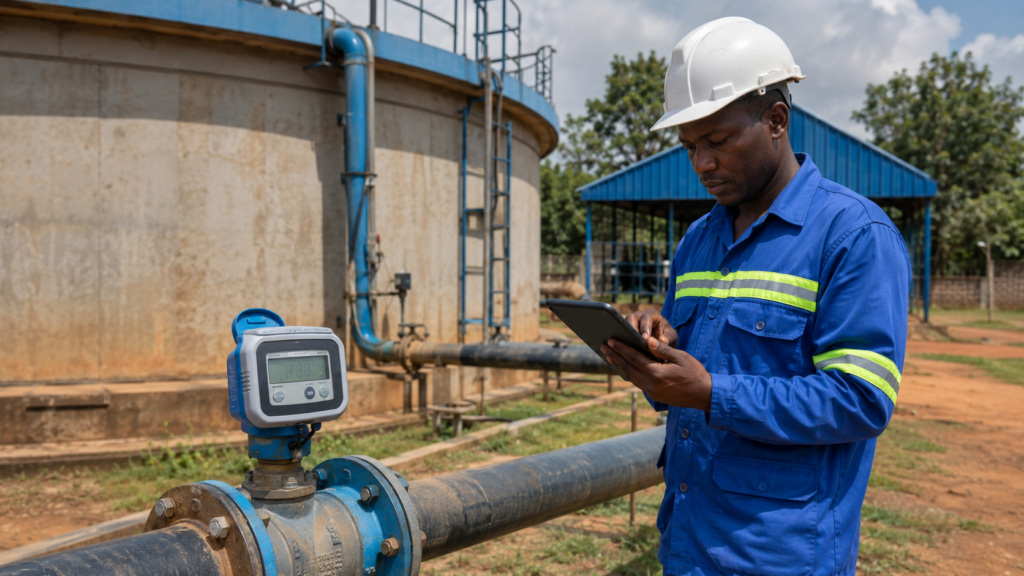
In FY 2024/25, Kenya’s water utilities lost an estimated 48% of the water put into supply — up from 44% the year before — to leaks, unmetered use, meter errors and bills that are never collected (Water Services Regulatory Board). That is nearly double the 20–25% the regulator considers acceptable, and it contributed to roughly KSh 14.9 billion in lost potential revenue in a single year. The figure explains why producing more water rarely fixes a utility’s finances: if almost half of every batch is lost, unmeasured, unbilled or uncollected, the problem is not only in the ground — it is in the data. A modern smart water billing system exists to close exactly that gap.
This article walks water service providers, county water departments, community projects and SACCOs through the practical journey from paper meter books to predictive analytics — and where water billing software in Kenya genuinely helps versus where engineering and governance still have to do the work.
Africa’s Water Utilities Have a Data and Revenue Problem
Non-revenue water (NRW) is simply the water a utility produces but is never paid for. It splits into two very different categories, and treating them the same is a common and costly mistake.
- Physical (real) losses — water that physically escapes the network through leaking pipes, burst mains, overflowing reservoirs and faulty joints. This water reaches no customer.
- Commercial (apparent) losses — water that does reach customers but is never correctly billed or collected: under-registering meters, illegal connections, estimated or skipped readings, transcription errors, incomplete customer records and uncollected arrears.
Physical losses need pipes, pumps and pressure management. Commercial losses need better information — and that is where most utilities are losing money without seeing it. The encouraging part is that commercial losses are usually the most immediately recoverable portion of NRW, because they are fixed with accurate data and disciplined billing rather than capital-intensive network works. You cannot manage what you cannot measure, and most billing offices still cannot measure it accurately.
Why Manual Meter Reading and Billing Hold Utilities Back
The traditional cycle looks familiar across much of the continent: a field officer walks the route, writes readings into a book, brings the book back to the office days later, and someone keys the figures into a spreadsheet to calculate bills by hand.
Every step in that chain leaks value:
- Delays — readings taken today may not become invoices for a week or more, stretching the cash cycle.
- Transcription errors — a single misread digit inflates or destroys a bill and triggers a dispute.
- Missing and estimated readings — skipped connections quietly become “estimates,” and estimates quietly become lost revenue.
- Billing disputes — without a photo or timestamp, the customer’s word competes with the officer’s, and the utility usually blinks.
- Weak audit trails — no reliable record of who read what, when or where.
- Cash handling — physical cash invites shrinkage and reconciliation headaches.
- Disconnected records — meters, customers, payments and connections live in separate books that never agree.
None of this is a staff-competence problem. It is a tooling problem, and it is solvable.
What Is a Smart Water Billing System?
A smart water billing system is not just an invoice generated on a computer instead of by hand. Its value is in the connections it creates. A true water utility billing system links, in one place:
- meter readings (captured digitally, ideally with photo and GPS evidence);
- tariff structures (applied automatically and consistently);
- customer accounts and connection records;
- bills and receipts;
- payments and reconciliation (including mobile money);
- customer notifications (SMS bills, reminders, confirmations);
- connection mapping; and
- management reporting on collections, arrears and coverage.
When those elements share one clean record, a reading taken in the field flows through to a bill, a notification, a payment and a dashboard without being re-typed. That single connected record is also the foundation everything more advanced — including analytics — will later stand on.
The Five Stages From Meter Reading to Predictive Analytics
Most utilities recognise themselves somewhere on this maturity curve. Progress is sequential: you cannot skip to Stage 5 while your Stage 1 records are still unreliable.
| Stage | Typical tools | Information available | Management approach | Main limitation |
|---|---|---|---|---|
| 1. Paper records & manual billing | Meter books, spreadsheets, cash | Delayed, partial, error-prone | Reactive; monthly at best | No real visibility or audit trail |
| 2. Mobile digital meter reading | Phones/tablets, reading app, camera, GPS | Faster, verified readings with location and photo | Supervisors track completed vs missed reads | Billing & payment may still be manual |
| 3. Automated billing & digital collection | Billing engine, SMS, M-Pesa, dashboards | Consistent bills, reconciled payments, live collections | Data-driven monthly management | Consumption data still periodic (monthly) |
| 4. Connected smart metering | Smart meters, IoT sensors, GIS | Frequent usage data, network mapping | Investigate anomalies earlier | Hardware cost, connectivity, power |
| 5. Predictive analytics | Analytics & forecasting models on clean data | Trends, forecasts, risk scores | Proactive; plan ahead of the report | Only as good as the underlying data |
The honest message: the biggest revenue gains for most Kenyan and East African utilities are still sitting in Stages 2 and 3. Digitising the meter-to-money journey pays for itself long before smart meters or AI enter the picture.
How Predictive Analytics Could Transform Water Utility Management
Once a utility has accurate, structured, reasonably frequent data, predictive analytics for water utilities becomes practical rather than theoretical. In plain terms, the system starts spotting patterns a human reviewing monthly totals would miss.
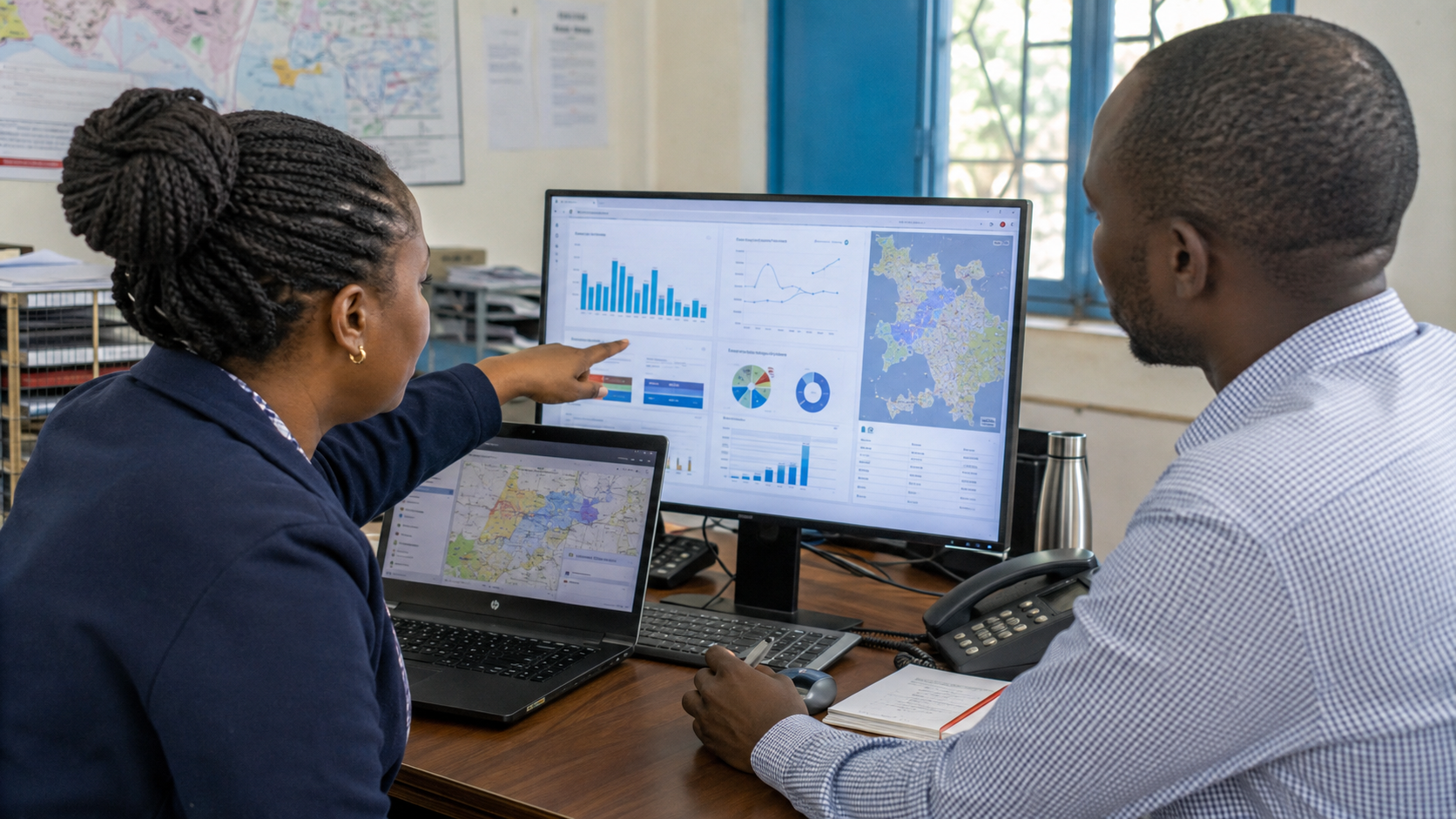
Realistic use cases include the ability to:
- flag unusual consumption that may indicate a leak, tampering, a misread or a faulty meter;
- forecast demand by zone, customer type or season;
- detect gradual meter degradation from drifting usage patterns;
- prioritise pipes, pumps and assets for inspection based on risk;
- highlight zones where supplied water and billed water diverge sharply;
- forecast expected billing and collections for the month ahead;
- segment arrears so revenue teams follow up the highest-value accounts first;
- surface dormant or inactive connections quietly costing money;
- optimise meter-reading routes and field assignments; and
- support capital investment planning with evidence rather than guesswork.
Can Smart Billing Reduce Non-Revenue Water?
Partly — and it matters which part. Better billing data directly attacks commercial losses. It reveals abnormal usage, exposes skipped or estimated readings, catches incorrect billing, identifies inactive meters and maps geographic patterns of loss. For many utilities, commercial losses are a large and immediately recoverable slice of NRW.
But software does not stop a physical leak. Reducing physical losses still requires field inspection, leak detection and repair, pressure management, bulk metering and ongoing network maintenance. A smart water billing system points the engineering teams to where to look and quantifies the loss — it does not pick up the spanner. Treat it as the diagnostic and revenue-protection layer that sits alongside your engineering and governance work, not as a replacement for either.
What African Utilities Must Consider Before Investing
A water utility digital transformation succeeds or fails on planning, not features. Weigh these factors honestly before you sign anything:
- Connectivity — will field officers have data coverage on every route, and can the app work offline and sync later?
- Power reliability — device charging and server/hosting uptime.
- Hardware and sensor costs — realistic budgeting, especially if smart meters are on the roadmap.
- Data quality — the state of your existing customer and meter records determines your starting line.
- Staff training — adoption by billing clerks and field officers is the make-or-break variable.
- Customer inclusion — not every customer has a smartphone; SMS and USSD keep everyone reachable.
- Interoperability — can the system exchange data with accounting, GIS and mobile money?
- Cybersecurity — billing and payment data are attractive targets and must be protected.
- Personal-data protection — compliance with Kenya’s Data Protection Act and the Office of the Data Protection Commissioner’s guidance.
- Vendor support — local, responsive support and training, not a licence handed over cold.
- Scalability — can it grow from a few thousand to hundreds of thousands of connections?
- Total cost of ownership — licences, hosting, SMS, support and training over several years, not the sticker price alone.
How MajiCloud Digitises the Meter-to-Money Journey
Mobile money is already deeply embedded in Kenya’s economy — the 2024 FinAccess Household Survey found that 82.3% of adults used mobile money — which is exactly why M-Pesa integration is now essential to an accessible water-billing and collection system. MajiCloud, by Africa Cloud Space, is built to move a utility cleanly through Stages 2 and 3 — the stages where most recoverable revenue actually sits. The workflow is deliberately simple.
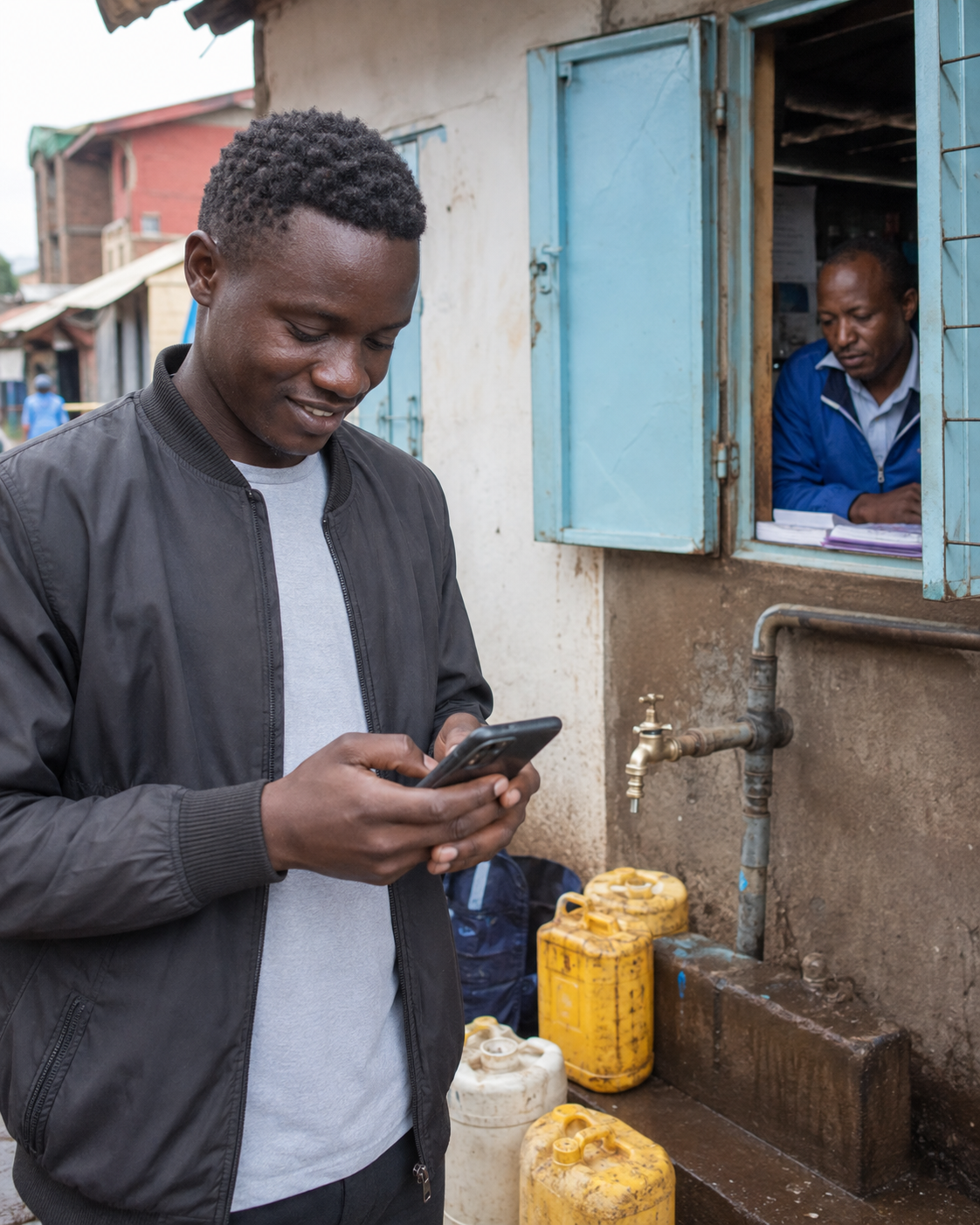
- Capture — a field officer records the reading on a phone, with photo evidence and GPS location confirming the connection.
- Bill — the system calculates consumption, applies the correct tiered tariff and generates the bill and receipt automatically.
- Notify — the customer receives an SMS with the bill and, later, reminders for overdue amounts.
- Collect & reconcile — the customer pays via M-Pesa, and the payment is reconciled against their account automatically, with a confirmation sent back.
Confirmed MajiCloud capabilities today include mobile meter reading with photo and GPS evidence, automated consumption-based billing with tiered tariffs, M-Pesa integration with automatic reconciliation, receipt generation, SMS bill notifications, payment confirmations and overdue reminders, GPS connection mapping, revenue analytics, collection monitoring, defaulter identification, and training and support.
A Practical Digital Transformation Roadmap
Skip stages and projects stall. This phased path lets each step fund and de-risk the next:
- Phase 1 — Clean the records. Correct and structure customer, connection and meter data. This unglamorous step determines everything after it.
- Phase 2 — Introduce mobile meter reading. Add photo and GPS verification; end the meter-book era.
- Phase 3 — Automate billing, SMS and M-Pesa reconciliation. Shorten the cash cycle and cut disputes.
- Phase 4 — Stand up management dashboards and data-quality controls. Make collections, arrears and coverage visible daily.
- Phase 5 — Pilot smart meters or IoT in selected zones. Learn where higher-frequency data pays off before scaling.
- Phase 6 — Introduce anomaly detection and predictive models. Only once enough reliable data has accumulated to trust the output.
Utilities that need help with the harder integrations can layer in custom software development, AI integration and automation, and cybersecurity support as the roadmap matures — not before the fundamentals are in place. For a deeper look at automating collections, see our guide to utility billing automation.
Is Your Utility Ready for Smarter Water Billing?
Before you commission a full audit, get an indicative sense of where revenue may be leaking. Enter your figures below — nothing is stored or sent anywhere.
Water Revenue Leakage Calculator
This result is indicative only. It uses simple ratios from the figures you entered and does not replace a formal non-revenue water audit, an engineering assessment or a standard water balance. Speak to a specialist before acting on these numbers.
Want to know what these numbers mean for your utility specifically?
Calculate Your Water Revenue Leakage Request a MajiCloud Billing & Revenue Assessment Schedule a MajiCloud DemonstrationThe Point Is Not More Data — It Is Better Decisions
The future of water management in Africa will not be decided by which utility collects the most data. It will be decided by which utilities turn accurate data into timely operational decisions — catching a misread before it becomes a dispute, spotting a dormant connection before another quarter is lost, and following up the right arrears first.
Predictive analytics is a worthy destination. But it is built on a foundation of clean meter readings, reliable billing, reconciled payments and structured customer records. MajiCloud is a practical starting point for exactly that foundation: digitise meter reading, improve billing accuracy, automate M-Pesa collections, and put management in front of the numbers — so that when the time comes for smarter analytics, the data underneath it can be trusted.
Frequently Asked Questions
What is a smart water billing system?
A smart water billing system connects meter readings, tariffs, customer accounts, bills, payments, notifications, connection mapping and management reporting in one place — so a reading captured in the field flows through to an accurate bill, an SMS, a reconciled payment and a dashboard without manual re-entry. It is far more than a computerised invoice.
How can digital water billing reduce non-revenue water?
It directly targets commercial losses by exposing abnormal usage, skipped or estimated readings, incorrect billing, inactive meters and geographic loss patterns. It does not repair physical leaks — that still needs field inspection, leak detection, pressure management and maintenance — but it tells engineers where to look and quantifies the loss.
What is the difference between mobile meter reading and a smart meter?
Mobile meter reading means a field officer captures the reading on a phone or tablet, often with a photo and GPS. A smart meter records and transmits consumption automatically, more frequently, without a human visit. Mobile reading is a low-cost, high-impact first step; smart meters are a later-stage investment.
How does M-Pesa integration improve water-bill collection?
Because mobile money is used by 82.3% of Kenyan adults (2024 FinAccess Household Survey), M-Pesa payments let customers settle bills instantly. Automatic reconciliation matches each payment to the right account, cutting cash handling, disputes and the reconciliation backlog.
What is predictive analytics in water management?
It is the use of historical and current data to anticipate what is likely to happen — forecasting demand, flagging usage anomalies, predicting meter degradation, prioritising assets for inspection and estimating expected collections — so managers can act before the monthly report, not after it.
Can community water projects use water billing software?
Yes. Community water projects, estates and small schemes benefit from the same fundamentals: digital meter reading, automated billing, SMS notifications and M-Pesa collection. Starting small with clean records and mobile reading is often the highest-return move a community project can make.
What information does a utility need before introducing predictive analytics?
Clean, structured and reasonably frequent data: accurate customer and connection records, reliable meter readings, consistent billing, reconciled payments and mapped connections. Analytics amplifies the quality of the data beneath it — so the foundation must come first.
Does MajiCloud work for small water utilities and SACCOs?
Yes. MajiCloud is designed to scale from small schemes and SACCO-run projects up to larger water service providers, digitising the same meter-to-money journey: capture, bill, notify, collect and reconcile — with training and support included.
Ready to build a reliable revenue foundation? See how MajiCloud digitises meter reading, billing and M-Pesa collection for water utilities across Kenya and East Africa.
Request a MajiCloud Billing & Revenue Assessment Schedule a Demonstration